Pages

Showing posts with label Hard disk drive. Show all posts

Monday, April 19, 2010

Power Consumption

Power consumption become increasingly important, not just in mobile devices such as laptops but also in server and desktop markets. Increasing data center machine density has led to problems delivering sufficient power to devices (especially for spin up), and getting rid of the waste heat subsequently produced, as well as environmental and electrical cost concerns. Similar issues exist for large companies with thousands of desktop PCs. Smaller form factor drives often use less power than larger drives. One interesting development in this area is actively controlling the seek speed so that the head arrives at its destination only just in time to read the sector, rather than arriving as quickly as possible and then having to wait for the sector to come around (i.e. the rotational latency). Many of the hard drive companies are now producing Green Drives that require much less power and cooling. Many of these 'Green Drives' spin slower (5,400 rpm compared to 7,200, 10,000 or 15,000 rpm) and also generate less waste heat.

Also in Server and Workstation systems where there might be multiple hard disk drives, there are various ways of controlling when the hard drives spin up (highest power draw).

On SCSI hard disk drives, the SCSI controller can directly control spin up and spin down of the drives.

On Parallel ATA (aka PATA) and SATA hard disk drives, some support power-up in standby or PUIS. The hard disk drive will not spin up until the controller or system BIOS issues a specific command to do so. This limits the power draw or consumption upon power on.

On newer SATA hard disk drives, there is Staggered Spin Up feature. The hard disk drive will not spin up until the SATA Phys comes ready (communications with the host controller starts).

To further control or reduce power draw and consumption, the hard disk drive can be spun down to reduce its power consumption.

Sunday, April 18, 2010

Hard Disk Drive


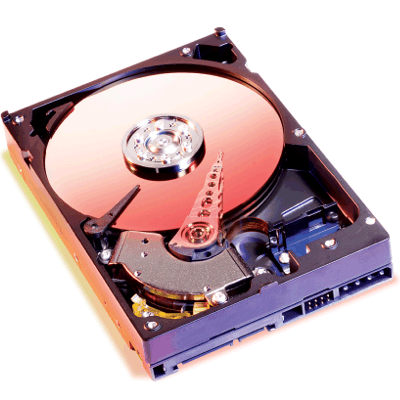
Hard disk drives records data by magnetizing ferromagnetic material directionally, to represent either a 0 or a 1 binary digit. They read the data back by detecting the magnetization of the material. A typical hard disk drive consists of a spindle that holds one or more flat circular disks called platters. The data are recorded onto the platters. The platters are made from a non-magnetic material, standard copy paper is 0.07–0.18 millimeters (70,000–180,000 nm) with an outer layer of carbon for protection. Older disks used iron(III) oxide as the magnetic material, but current disks use a cobalt-based alloy.

The platters are spun at very high speeds. Information is written to a platter as it rotates past devices called read-and-write heads that operate very close (tens of nanometers in new drives) over the magnetic surface. The read-and-write head is used to detect and modify the magnetization of the material immediately under it. There is one head for each magnetic platter surface on the spindle, mounted on a common arm. An actuator arm (or access arm) moves the heads on an arc (roughly radially) across the platters as they spin, allowing each head to access almost the entire surface of the platter as it spins. The arm is moved using a voice coil or in some older designs a stepper motor.

Hard Disk Drive


Hard disk drives was first introduced in 1956 as a data storage device for an IBM accounting computer. Then hard disk drives were originally developed for use with general purpose computers. During the 1990s, large-scale industries needed a reliable storage device that can work independent of a particular device, this lead to the introduction of embedded systems such as RAIDs, network attached storage (NAS) systems, and storage area network (SAN) systems that provide efficient and reliable access to large volumes of data. In the 21st century, HDD usage expanded into consumer applications such as camcorders, cellphones (e.g. the Nokia N91), digital audio players, digital video players, digital video recorders, personal digital assistance and video game consoles.

Hard Disk Drive

Hard Disk Drive

A
hard disk (often shortened as hard disk, hard drive, or HDD) is anon-volatile storage device that stores digitally encoded data on rapidly rotating rigid (i.e. hard) platters with magnetic. Strictly speaking, "drive" refers to the motorized mechanical aspect that is distinct from its medium, such as a tape drive and its tape, or a floppy disk drive and its floppy disk HDDs had removable media; however, an HDD today is typically a sealed unit (except for a filtered vent hole to equalize air pressure) with fixed media.

Lijit search